Showing posts with label Neural. Show all posts

Friday, 27 September 2013

Impact of Illusive Advertisement

Marketing is defined as an organization function and a set of processes for creating, communicating and delivering value to the customers and for managing customer relationships in ways that benefit the organization and its stakeholders.  Earlier when the brands catering to the needs of the customer were limited there was less of the competition but as the brands increased so did the competition. The rules of the market were simple and everybody was enjoying their share. With the due course of time communication became one of the top priorities. The important mediums constituted print, television, radio, fliers, billboards, mail, telephone, posters, CDs. Audiotapes and internet. Brands wanted to grow by increasing the size of the markets but slowly and slowly with the increasing coverage snatching away of the market share from the competitors became important to survive. Some ground rules were laid down by advertising council of India so that competition may not turn into a hostile war. 

Recently Colgate and Pepsodent two oral health care brands are caught up in defaming case against other. The campaign was so noticeable that even though somebody missed it by chance on television the news covered it up. Earlier also so many similarly themed advertisement talking about brushing the teeth, cavities, germi check have appeared on television. But this one did its task very well meaning to say covering a big chunk of the target audience. Though the case is still going on in the court Pepsodent was able to come in news.


Does the brand appreciate the fact that it has come in the limelight by whatsoever means?

Taking another example of the print ad which was created for fun in the year 2002 and had no implications for the brand communication became viral few days back.
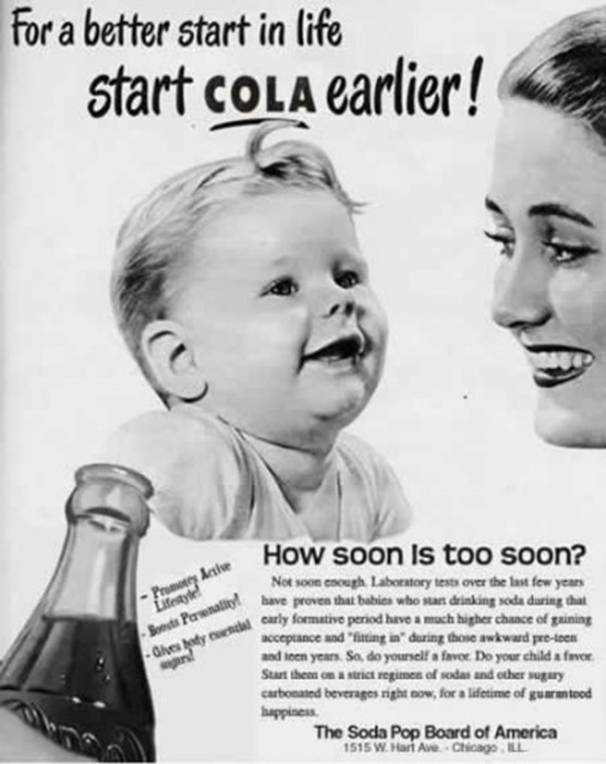


The ad says that the earlier the kids start drinking Cola better it will be for their future. However the person who has made this advertisement says it has no implications for promoting the brand.

Now let us try to understand what does this type of advertisement says at subliminal level. Earlier advertisements used to provide the apt information and people could trust on that while making decision making. But now when the information provided in the advertisement is objectionable. Where does the responsibility of media lies? In the earlier example of Colgate vs Pepsodent  there have been charges that no such laboratory test actually existed which has been shown in the commercial.

The vintage advertisement of Cola shows the name of the “The soda pop board of America” which is nothing. Also the claims done in the advertisement are just baseless. What harm does this misleading advertisement do? These type of advertisements because of their unique claims catches the attention of the audience and then works at the subliminal level. Since not every viewer will cross check or verify the facts and figures they at their subconscious level make an acceptable premise. In future that information which gets stored gives an optimistic purview. Even though a person can straight away negate the claims (as done in the cola ad), but somewhere down the line if somebody supports that idea the response would be positive. This is how advertisements take the people away from realty at a very minute level of consciousness. In case of advertisement of Pepsodent and Colgate though Colgate is the market leader, Pepsodent will be successful in this attempt if its distribution becomes equally strong as of Colgate and it increases its visibility too by 130 percent. The prime advantage which it can bang upon is top of the mind recall because of the free publicity it has earned. Now if that is in sync with the supply chain it can be a successful moment for the brand.

Ethically speaking this type of advertisement claims should be strictly banned and be discouraged. A strict action should be taken for their course of action so that there should not be any misleading effect. The whole purpose of communications gets defeated and it will cost dearly in the future.


Monday, 27 May 2013

Hate speech communication by modern day politicians


Hate speech has become very common now a days by the modern day politicians be it any political party. This issue has again come to light in a recent case of Varun Gandhi. Let’s look at the few lines of his speech. Following are the excerpts of speech:

Yeh panja nahi hai, yeh kamal ka haath hai. Yeh kat** ke galey ko kaat dega chunaav ke baad. Jai Shri Ram! Ram ji ki jai! Varun Gandhi kaat daalega! Kaat denge us haath ko, kaat denge, kaat daalega!
Apne jao, apne gaon mein jao aur halla karo ki saara Hindu ek tarfa ho jao, chhetra ko Pakistan hone se bachao, aur saara Hindu ek tarfa ho jao! - See more at:
Kya yeh sach nahin hai… ki usko bola gaya ki mataji aapka naam kya hai... agar usne bola ki Bimla Devi, to usko kahaa ki dekhenge, sochenge... pehle paanch hazaar rupaye do... aur agar uska naam hai Saira Bano ya jo bhi Begum Hukum Begum... hum to jaante nahin hain... badey daraawne naam hotey hain inke... Karimullah... Mazharullah.... agar raat ko kabhi dikh jaayen... to darr rahen hain... - http://www.indianexpress.com/news/-badey-daraawne-naam-hotey-hain-inke...-karimullah-mazharullah...-varun-gandhi-kaat-daalega...-/435950/#sthash.2UNXU541.dpuf

Post reading these lines any Muslim will feel offended and this will create a feeling of communalism. What is the motto of these speakers when they use such language? Another similar case of Owaisi also became the headline and then he too got rid-off the charges. They very well know that their speech will create havoc but still they dare to use such language. They try to appease their voters by exclusively targeting them, however they forget that they do have people of the all religion in their party. Still they commit such blunder. What is the underlying thought process when they do such activity?

Well instant gratification is the underlying cause. People have become so impatient that they need the result instantaneously. The quick applaud by the group of people gives them immense satisfaction of victory. The very basic nature of human being to be admired by the audience and applaud by them takes him to the state of mind that whatever he is saying is proving to be effective. The emotional rush of adrenaline boosts him further to emphasize on those things which he thinks will be liked by the audience and this in turn ensures his vote bank politics. Some people may say that this is divide and rule policy but a wise leader is the one who follows the united stand take for example Narendra  Modi. He has very wisely come out of the grave situation and won the hearts of people of his state. If we go through the content of speech of Narendra Modi he uses a very influential language which proves to be quite effective.

But a very interesting after result of these speeches is the politicians very easily get away with the judiciary system. They create a headline for some days and then everything disappears. Is this the right way a democratic nation should work on? India is a country with so many religions and diverse culture, this hate speech communication is a very dangerous issue that can slowly and slowly divide people on the basis of their religion and can lead to communal riots. If the frequency of these speeches increases then people will start having mindset of hatred against the other religion especially among the illiterate people in India.

Hate speech law in India ensures right punishment for the person indulging in such activities. But then where is the flaw. Media should act as an important tool to solve these issues. If hundreds of people are present as their audience and there is a live coverage of the same then how come there is a gap in these issues. Media should proactively take these issues seriously and be able to create a movement which can bring the guilty to picture. Otherwise what people will think is the media in India is in total control of the politicians. Any movement for promoting mutual harmony like recent one Bharat Nirmaan will do less of positive impact as compared to the destruction caused by the communal leaders. Shouldn’t there be a strict code of conduct for these people. What call should the media aptly take? Innumerable questions but without any positive answer. Is there a loophole in the judiciary system which needs to be revisited? Hope for a bright future of Indian politics unless some strict course of action is taken for inappropriate activities.


Monday, 9 January 2012

Why do we behave in a particular manner in a lift?


If the elevator is crowded, everybody stands still, stares at the ceiling, at the floor or the button panel as if never seen before. If two strangers are together in the elevator, they stand as far as possible from each other, don’t face each other directly, don’t make eye contact and don’t make any sudden movements or noises. Much of people’s behavior in elevators is not the result of rational thinking. It’s an automatic, instinctive response to the situation. There is an artificial threat of aggression, and yet mind responds as if it is, and produces behaviors meant to protect ourselves.
Imagine two Paleolithic cavemen who follow the tracks of a large bear into the same small, dark cave. There is no bear in there, only the other hungry caveman ominously waving his club: clearly an awkward situation that requires an exit strategy. In those Paleolithic days, murder was an acceptable way to get out of socially awkward situations. In the cave, one of the cavemen whacks the other over the head with his club and the party is over. Similarly, when male chimpanzees in Uganda encounter a male from another group, they slash his throat and rip his testicles off — just in case he survives and has any future ambitions for reproduction.
Our minds have evolved from the minds of the cavemen, and their minds, in turn, evolved from the minds of their primate ancestors — apes that looked lot like chimpanzees. Some of our mental abilities like our ability for abstract reasoning, language, love or spirituality make us different. But the way primate minds respond to potentially dangerous social situations hasn’t changed in millions of years.
When two rhesus macaques are trapped together in a small cage, they try everything they can to avoid fighting. Moving with caution, acting indifferent and suppressing all the behaviors that could trigger aggression are good short-term solutions to the problem. The monkeys sit in a corner and avoid any random movements that might inadvertently cause a collision, because even a brief touch could be interpreted as the beginning of hostile action. Mutual eye contact must also be avoided because, in monkey language, staring is a threat.
The monkeys look up in the air, or at the ground, or stare at some imaginary point outside the cage. To avoid immediate aggression, and also to reduce stress, an act of communication is needed to break the ice and make it clear to the other monkey that no harm is intended or expected. Macaque monkeys bare their teeth to communicate fear and friendly similarly humans smile
 However people react very differently in a glass elevator. They tend to look out at the view rather than face the doors. They also tend to use the fact that there is a view to break the ice and act more casually. They even speak sometimes which is highly unusual in mundane elevators because people don't like the idea of being overheard by strangers. The presence of a young child in the elevator also serves as an ice breaker. Virtually everyone will smile at child who wants to push the button and who makes a comment about the sensation of movement. 

Evolving facet of Web Series amongst Indian Viewers

Viewing habits of people determine where the overall growth of any society. If any brand or any marketer wants to understand any marke...